Jan 02, 2026
H100 vs H200: Performance, Memory, Cost, and Inference Benchmarks (2026)
Cost Optimization
Distributed Inference
H100 and H200 look similar on paper, but their differences matter in memory-bound LLM workloads. H200’s 141GB HBM3e and ~4.8 TB/s bandwidth shift the bottleneck from compute to memory, making it better suited for long-context inference, high-concurrency serving, and larger batch sizes. The real question isn’t peak FLOPs — it’s whether your workload is constrained by memory, bandwidth, or cost per useful output.
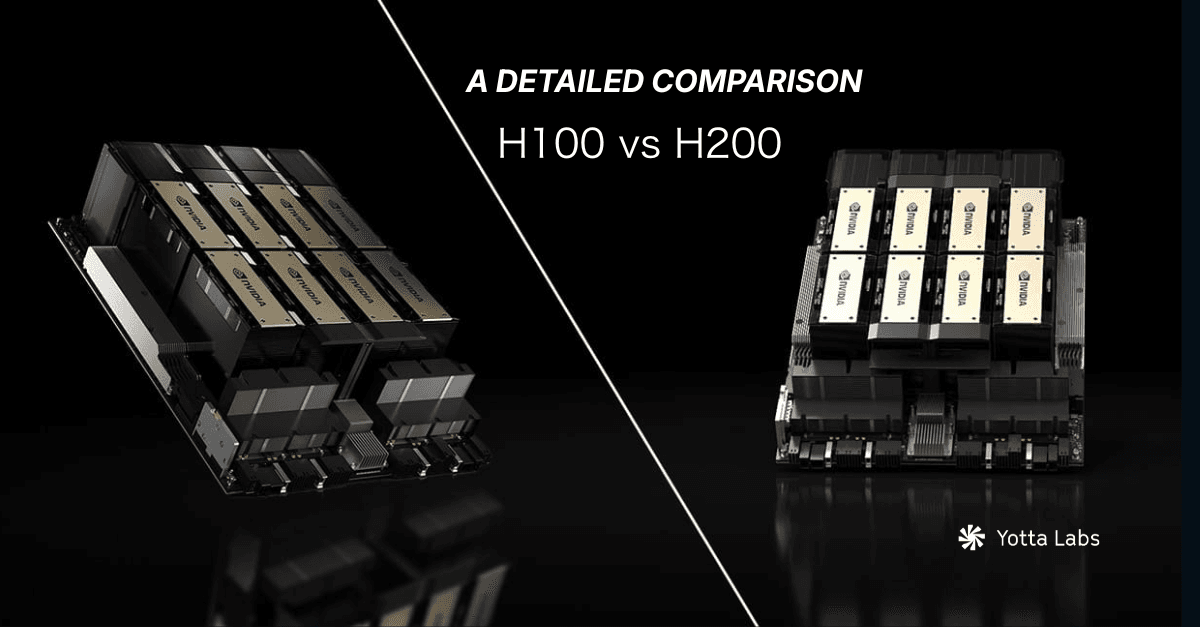
If you're choosing between NVIDIA H100 and H200 for LLM training or production inference, the confusing part is that the headline compute specs look similar, but real-world performance and costs can diverge—especially for memory-bound LLM inference, long-context workloads, and large-batch serving.This guide breaks down the differences that actually matter to AI developers: memory capacity, memory bandwidth, inference throughput signals (MLPerf), and cost-per-token implications—plus a practical decision framework for 2026.
What Changed From H100 to H200
H200 is basically "H100 + much more and faster memory". The most meaningful upgrades are 141GB HBM3e and 4.8 TB/s bandwidth, versus H100’s 80GB HBM3 and 3.35 TB/s bandwidth.
H100 vs H200 Specs Comparison
| Spec (SXM class) | H100 | H200 |
| Architecture | Hopper | Hopper |
| Memory | 80GB | 141GB |
| Memory bandwidth | 3.35 TB/s | 4.8 TB/s |
| FP8 Tensor (peak) | 3,958 TFLOPS | 3,958 TFLOPS |
| NVLink (SXM) | 900 GB/s | 900 GB/s |
Developer takeaway: H200's "win condition" is memory size + bandwidth, not peak tensor FLOPS.
Why H200 Often Feels Faster for LLM Inference
- Bigger VRAM = fewer "workarounds"
For production inference, you pay memory costs in multiple places:
- model weights
- KV cache (grows with context length × batch size)
- activations + runtime overhead
The jump from 80GB → 141GB often lets you:
- increase batch size safely (higher utilization, lower $/token)
- run longer context windows without KV cache thrash
- reduce tensor parallel fragmentation on mid/large models
This is why H200 can materially improve "stability under load" even when peak compute looks unchanged.
- Bandwidth matters for attention + KV cache
H200’s 4.8 TB/s bandwidth reduces memory stalls in attention-heavy inference compared to H100’s 3.35 TB/s. On modern LLM serving stacks, you often hit "effective throughput" ceilings from memory movement—not tensor math.
Inference Benchmarks: What the MLPerf Signal Says
You'll see different claims floating around; the useful way to read it is:
- MLPerf is not your exact workload
- but it's a standardized directional indicator
H200 Llama 70B inference can achieve ~11% higher throughput than the best H100 results they compared against (MLPerf context).Interpretation for developers: H200 isn't "2× faster" than H100 for inference. It’s typically single-digit to low-teens percent faster on some standardized inference scenarios—but it can be meaningfully easier to run (larger batch / longer context) because the memory jump is huge.
Training: When H100 vs H200 Changes Less Than You Expect
For training, you're often constrained by:
- NVLink / NVSwitch topology
- scaling efficiency
- optimizer state + activation checkpointing
- inter-node network
H200 can still help when your training job is memory-limited (e.g., larger batch, bigger sequence length), but "pure FLOPS" gains are not the point. The most consistent training benefit is more models fit comfortably per GPU before you add complexity.
Cost: The Only Metric That Matters in Production Is $/Useful Output
Don’t choose based on $/GPU-hour alone.For inference, the metric is closer to:$/token = (GPU hourly price) / (tokens per second × 3600)H200 can win on $/token even if its hourly price is higher, if you can translate the extra memory into:
- higher batch
- fewer OOM restarts
- fewer replicas to hit P95 latency
- higher sustained utilization
A simple developer decision rule
Choose H200 if you are:
- serving long context regularly
- memory-bound on KV cache
- pushing batch throughput
- running bigger models where 80GB forces painful sharding
Choose H100 if you are:
- cost-constrained and not memory-bound
- doing mixed workloads where 80GB is enough
- already optimized around Hopper and don’t need 141GB VRAM
Quick Recommendations by Workload
LLM Inference (production)
- H200 for long-context, high concurrency, memory pressure
- H100 for standard contexts, cost-sensitive endpoints
Fine-tuning (LoRA/QLoRA) and Training
- H200 if you want bigger batch / higher seq length without gymnastics
- H100 if your pipeline already fits comfortably
FAQ
Is H200 faster than H100?
Often modestly faster in standardized inference scenarios, but the biggest improvement is 141GB memory + 4.8 TB/s bandwidth.
Does H200 have more compute than H100?
Peak FP8 numbers are similar; the upgrade is primarily memory.
Which is better for long context?
H200, because KV cache pressure is real and memory size matters.
Deploy on Yotta (Cost-Optimized Paths)
If you want to compare apples-to-apples, the fastest way is to run your own micro-benchmarks:
- vLLM / SGLang serving
- your real prompts & context
- batch/latency targets
On Yotta, you can spin up both quickly (US regions) and measure $/token directly. (Your starting prices: H100 $1.75/hr, H200 $2.10/hr.)