
Jan 04, 2026
B200 vs H200: Which GPU Is Better for Large-Scale AI in 2026?
Cost Optimization
Distributed Inference
If H200 is “Hopper with more memory,” B200 is a different class entirely. Blackwell raises the throughput ceiling for both training and inference, with MLPerf-related reporting showing roughly ~3× higher throughput on Llama 2 70B Interactive for 8× B200 vs 8× H200 systems. The real decision isn’t about peak FLOPs—it’s whether B200 reduces the number of GPUs required to hit target QPS, improves scaling efficiency at cluster level, and lowers $/token in production.
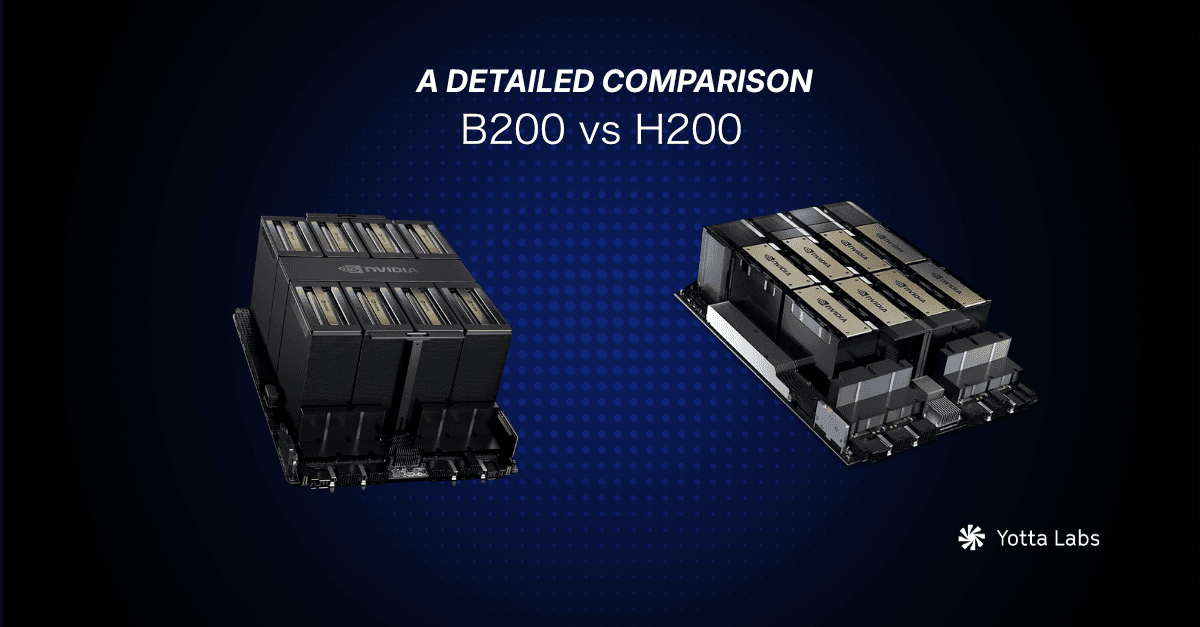
If H200 is "Hopper with much more memory", then B200 is a different category: Blackwell changes the throughput ceiling for both training and inference—especially when you use modern low-precision inference formats and large-scale NVLink fabrics.For AI developers building large-scale systems, the real question is not "which GPU is faster", but:
- Will B200 reduce the number of GPUs I need for the same target throughput?
- Will it materially improve scaling efficiency at cluster level?
- Will it lower $/token in production, not just improve peak benchmarks?
This guide covers specs, real benchmark signals (MLPerf), and decision criteria you can actually use.
B200 vs H200: Specs That Matter
H200 (Hopper): 141GB HBM3e, 4.8 TB/s bandwidth. B200 (Blackwell): up to ~192GB-class HBM3e per GPU (platform dependent), with much higher bandwidth class (up to ~8 TB/s) and NVLink 5 at ~1.8 TB/s per GPU in Blackwell-era systems. At the system level (8-GPU HGX/DGX class), NVIDIA lists HGX B200 with ~1.4 TB total memory.
The MLPerf Signal: B200 Can Be “Multiple X” Faster in LLM Inference
For LLM inference, the strongest public directional data point is from NVIDIA’s own MLPerf analysis:
- On Llama 2 70B Interactive, an 8× B200 system achieved ~3.1× higher throughput vs an 8× H200 system (in the NVIDIA submission context).
A second independent (but still “benchmark context”) datapoint states that HGX B200 outperformed HGX H200 by about ~3× on Llama 2 70B in their MLPerf-related reporting, quoting ~101k tokens/s vs H200 in their setup. Developer interpretation: B200 isn't a small step. For modern LLM inference (especially when optimized), it can be a step-function improvement.
Why B200 Wins: It's Not Just "More FLOPS"
1. Memory bandwidth and feeding the GPU
B200-class bandwidth (up to ~8 TB/s in Blackwell materials) reduces stalls in attention and large GEMMs, especially under concurrency.
2. Interconnect matters at scale
Blackwell-era NVLink is discussed at ~1.8 TB/s per GPU class, which changes the ceiling for multi-GPU sharding and model-parallel inference/training.
3. “System-level” advantage grows with workload size
As model size, context length, and concurrency increase, B200’s advantage typically grows because the system spends less time waiting on memory and communication.
When H200 Still Makes Sense
B200 is not always the correct choice.Pick H200 when:
- Your workload is memory-limited vs compute-limited, and H200 already solves it.
- Your models fit well within 141GB and you don’t need Blackwell’s throughput ceiling.
- B200 availability / pricing / cluster topology is not favorable.
- You want "known good" Hopper stack maturity for your current pipeline.
H200 remains a strong "big memory Hopper" option with clear specs: 141GB HBM3e at 4.8 TB/s.
When B200 Is the Right Move (Most Large-Scale AI Teams)
Pick B200 when:
- You’re doing large-scale inference (high QPS / long context)
If your product is inference-heavy, B200’s multi-x throughput signal means:
- fewer GPUs to serve the same QPS
- less replica overhead
- lower $/token at scale (if priced reasonably)
- You're training frontier-ish models or pushing scaling
For multi-node training, you benefit from:
- higher effective throughput per node
- better scaling efficiency signals in modern systems (and vendors are demonstrating scaling on B200 clusters).
- You need "AI factory" style density
If you’re building clusters where each node must carry more of the load (network/power/rack constraints), B200 generally has a stronger density story (system-level numbers like DGX/HGX B200 are designed for it).
A Practical Developer Decision Framework
Step 1: Decide what your bottleneck is
- memory capacity → H200 might be enough
- throughput / concurrency / scaling → B200 likely wins
Step 2: Benchmark with your serving stack
Use a simple plan:
- vLLM or SGLang
- your real prompt distribution
- target latency (P95/P99)
- measure tokens/sec and $/token
Step 3: Compare "cluster cost" not "GPU cost"
At scale, what matters is:
- GPUs required to hit target QPS/training step time
- utilization stability
- operational complexity (sharding, retries, autoscaling)
FAQ
Is B200 better than H200 for LLM inference?
In MLPerf-related reporting, 8× B200 showed ~3.1× throughput vs 8× H200 on Llama 2 70B Interactive (submission context).
Does H200 have more memory than B200?
H200 is 141GB. B200 is generally cited in the ~192GB-class HBM3e range depending on platform docs; system-level HGX B200 is listed with ~1.4 TB total across 8 GPUs.
What’s the biggest reason to choose B200?
If your bottleneck is throughput + scaling (not just "fit the model"), B200 is a step-function upgrade.
Deploy on Yotta (Fastest Way to Decide)
A serious team shouldn’t pick from spec sheets alone. The right approach is:
- run your real workload
- measure tokens/sec under load
- convert to $/token
On Yotta, you can benchmark both quickly (US regions). (Your starting prices: B200 $4.40/hr, H200 $2.10/hr.)